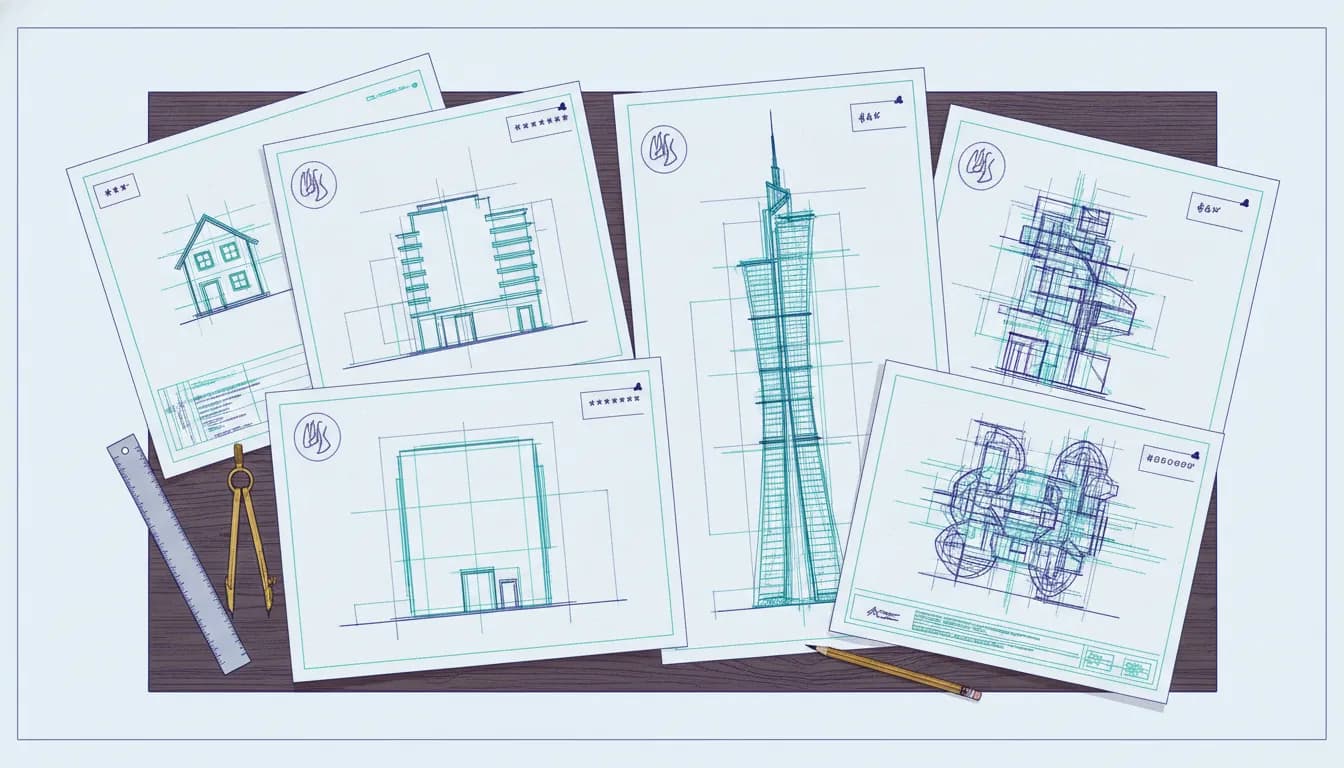
How to Write a Project Brief That Gets You Accurate and Consistent Quotes from Developers
 Sharan Sifat17 min read0 views
Five developers, five wildly different quotes for the same idea? The problem is usually the brief. Here is how to write a project brief that gets accurate, consistent quotes from developers — with a template, a feature-detail example and acceptance criteria you can copy.
On this page
If you want accurate, consistent quotes from developers, the fix is almost always the same: write a project brief that removes ambiguity. Describe the problem you are solving, the people you are solving it for, every feature in testable detail, and the visual direction in your head. When several developers read the same clearly defined brief, their estimates stop scattering — because they are finally pricing your project instead of five different guesses about what you meant. Download our free project brief template to get started.
Most founders skip this step, send a two-line email, and then feel blindsided when the numbers come back ranging from a few thousand dollars to the price of a car. This guide shows you how to write a project brief that ends that guesswork: the exact sections to include, how much detail each feature needs, the visual references that prevent costly redesigns, and the mistakes that quietly reintroduce ambiguity. Whether you are hiring a freelancer or briefing an agency for SaaS development, the same principles apply.
- Quotes vary because a vague brief lets every developer imagine a different project — not because someone is padding or cutting corners.
- Lead with the problem, the users, and the business context before you list a single feature.
- Specify each feature so that "done" is testable, using acceptance criteria written as Given / When / Then.
- Include three to five annotated visual references so nobody has to guess what "modern and clean" means to you.
- State your budget range, timeline drivers, and what is explicitly out of scope so every quote covers the same work.

Why do developer quotes vary so wildly for the same project?
You have an idea for an app or a website and you are ready to invest in building it. So you reach out to five developers or agencies. Developer A quotes $2,500. Developer B says $8,000. Developer C comes back at $22,000. Developer D wants $15,000 and six months. Developer E offers $5,000 and promises it in three weeks. You are now more confused than before you asked.
Are A and E cutting corners? Is C padding the number? Is the project actually worth $2,500 or $22,000? The uncomfortable truth is that they are not looking at the same project. Each is looking at their own interpretation of your idea, filtered through their own clients, experience and imagination. When a brief is vague, every developer fills the blanks differently. Developer A pictures a simple five-page website because that is what most of their clients need. Developer C pictures a complex web application with custom features because that is what their typical projects involve. Neither is wrong — the brief never gave enough detail to make one reading clearly correct.
| Developer | Quote | Timeline | What they quietly assumed |
|---|---|---|---|
| A | $2,500 | ~3 weeks | A simple five-page brochure site — their most common job |
| B | $8,000 | ~6 weeks | A small web app with basic accounts |
| C | $22,000 | ~4 months | A custom application with bespoke features |
| D | $15,000 | 6 months | Everything, built carefully, with buffer |
| E | $5,000 | 3 weeks | A templated build with minimal edge cases |
This is nobody's fault. No one teaches founders how to write a project brief, and developers can only price what they can see. But it is a solvable problem, and solving it saves you thousands of dollars, weeks of calendar time, and a great deal of frustration.
The interpretation gap, not dishonesty
Look again at that spread. The highest quote is nearly nine times the lowest, and yet every developer may be quoting honestly. The gap is not measuring integrity; it is measuring how much you left to the imagination. Estimating is really a form of risk pricing. When a requirement is fuzzy, a careful developer adds buffer to protect themselves and a careless one ignores it and blows the budget later — but both are guessing. Tighten the brief and the guessing shrinks, so the numbers move toward each other.
A wide spread in quotes is diagnostic. If the highest number is several times the lowest, that gap is measuring the ambiguity in your brief, not the honesty of the people quoting. Tighten the brief and the numbers converge.
What is a project brief, and what should it actually contain?
A project brief is a single document that describes what you want built, for whom, and why — in enough detail that a developer can estimate the work without guessing. It is not a contract, a wireframe, or a technical spec written in engineer-speak. It is a plain-language description of the project that happens to be complete enough to price.
A dependable brief covers five things:
- Context — the problem, the users, and the business situation.
- Functional requirements — every feature, described so that "done" is testable.
- Design direction — references, brand assets, and sketches.
- Non-functional requirements — performance, security, compliance, and expected load.
- Constraints — budget range, timeline drivers, and what is explicitly out of scope.
The more of these you answer up front, the less a developer has to price the risk of the unknown. A precise brief lets both a cautious and an optimistic developer quote the same real work rather than two different imagined ones. If you are still deciding between a hosted builder and a custom web application, the brief is also where that trade-off becomes obvious — the moment you write down what you actually need, the limits of a template usually announce themselves.
Start with the problem and the people, not the solution
The most effective briefs open with context, not a feature list. What problem does your product solve? Who has this problem? How do they cope today, and why are existing tools insufficient? This matters because it gives developers the why behind the build. When they understand the underlying problem, they make better technical calls, suggest simpler paths you had not considered, and flag risks early — all before a number is written down.
Describe the real problem you are solving
Say your brief reads only "build an appointment scheduling app." A developer might reasonably assume a full-featured system: calendar sync, automated reminders, payment processing, multi-location support. But if your brief explains that you run a small dog-grooming business, that bookings currently happen by phone and on a paper calendar, that this is causing double-bookings and missed appointments, and that you simply need clients to see open time slots and book online, the scope snaps into focus. The developer immediately understands what is — and is not — being asked for, and the estimate gets far more accurate.
Who exactly are your users? Define them in concrete detail
Describe your target users concretely. Are they tech-savvy young professionals who live on their phones, or older adults on desktop computers who may be uneasy with dense interfaces? Are they on fast, reliable connections, or in regions where connections are slow and data is expensive? Will they open the app daily or once a month? These traits drive design decisions, performance requirements and feature complexity — and all three move the quote. Building well for slow networks and low-end devices, for instance, is real engineering work; Google's own web.dev performance guidance exists precisely because it is non-trivial.
Add the business context that changes the cost
Include how many users you expect at launch and how quickly that number should grow — the architecture for a hundred users and for a hundred thousand is not the same architecture, and retrofitting the difference is expensive. Note any hard deadline and what drives it: an investor meeting, a seasonal launch, a regulatory date. And flag compliance obligations early. Handling health data pulls in HIPAA obligations; taking card payments pulls in PCI DSS. These are not line items you bolt on at the end — they shape the architecture, so they belong in the brief from the start.
Write the context section as if you were explaining the business to a smart friend who has never seen it. If a developer can finish that paragraph and accurately describe your customer back to you, you have written it well.

How do you describe features so developers stop guessing?
This is the section where most people fall short, and it is where vagueness costs the most money. Every feature needs enough detail that a developer can build it without inventing the parts you left out.
What insufficient feature detail looks like
Here is a single line from a typical brief: "Users should be able to create accounts and log in." One sentence, dozens of open questions. Can users sign up with email, phone number, social accounts, or all three? Is email verification required? What is collected at signup — just email and password, or also name, phone, company, profile photo? What are the password requirements? Is two-factor authentication needed? Can users log in with biometrics on mobile? What happens when someone forgets their password? Can users delete their account, and what happens to their data if they do? Are there multiple roles with different permissions? Every one of those questions is a fork in the road, and every developer will take a different branch.
"Users can log in" hides at least eight decisions — signup methods, verification, password rules, two-factor, recovery, roles, account deletion, and data retention. Leave them unwritten and each developer prices a different set of them. That one line is where quotes quietly diverge.
What sufficient feature detail looks like
Here is the same feature written so that nobody has to guess:
User registration and authentication. Users can sign up with email and password or Google social login. During email signup, users provide full name, email address and password. Passwords must be at least 8 characters with one uppercase letter and one number. After signup, users receive a verification email with a confirmation link that expires after 24 hours; they cannot access the dashboard until the email is verified. Google login pulls name and email from the Google account automatically. New users then land in a short onboarding flow where they upload a profile photo and set their timezone. Password recovery is available by email with a reset link that expires after one hour. From account settings, users can update name, email, password, profile photo and timezone, and can delete their account — which removes all personal data within 30 days per our privacy policy.
The detailed version leaves virtually nothing to interpretation. A developer reading it knows exactly what to build and can estimate the effort accurately. Not every feature needs a paragraph this dense, but the ones that carry real complexity — payments, permissions, notifications, anything that touches other people's data — do. Payment processing is a good example: adding it is not a checkbox. Stripe's standard published pricing is 2.9% + 30¢ per successful card charge in the US, and on top of the fee there is real work to handle refunds, disputes, webhooks and failed payments. If your brief says only "add payments," you have hidden all of that from the estimate.
Write acceptance criteria that define "done"
For each meaningful feature, add acceptance criteria — specific, testable conditions that must be true for the feature to count as complete. A simple, durable format is Given / When / Then:
Given a user is on the signup page, when they submit a valid email and password, then they receive a verification email within 60 seconds and see a confirmation message on screen.
Acceptance criteria do double duty. They force you to think through edge cases while you write, and they give both sides an objective definition of finished — which is exactly what prevents the "but I thought this was included" argument at the end of a project. Writing features at this level takes time; plan for several hours, or a couple of days for a substantial product. But every hour spent specifying saves multiple hours of development, rework and miscommunication. It is the single highest-return investment you can make before a line of code is written. It is also the same discipline that separates the projects that ship from the ones that quietly fail.
A brief is not paperwork. It is the difference between five quotes for five imaginary projects and five quotes for yours.
Give developers visual references and design direction
Words, however carefully chosen, are inherently ambiguous when they describe visual design. What you picture when you read "modern, clean interface" is almost certainly not what your developer pictures, and that gap is a major source of mismatched expectations and costly revisions. The fix is to show, not tell.
Collect three to five reference apps and annotate them
Find three to five existing apps or websites with elements you admire, and include screenshots with annotations that say exactly what you like. Do not just write "I like this site." Write "I like the clean navigation bar with the logo on the left and a single call-to-action button on the right," or "I like how the hero section uses a large image with text overlaid on it," or "I like this palette — dark blues with orange accents." Point to specific elements across different references: the navigation of one app, the card-based layout of another, the typography of a third, the mobile experience of a fourth. That collage communicates your taste far better than any adjective could.
Include brand guidelines and rough sketches
If you already have brand guidelines, include them: logo files, brand colors with hex codes, approved fonts, voice guidelines, and any existing marketing material. They help the team make the product feel like a natural extension of your brand rather than a stranger wearing your logo. And do not underrate rough sketches. If you have drawn the layout of a key screen on paper, photograph it and add it — a sketch communicates spatial relationships and content hierarchy in a way that prose cannot. The goal is not polish; it is removing the guesswork about layout and priority before anyone starts building.

How should you structure a project brief? A simple template
You do not need a fancy tool — a shared document with clear headings works. Here is the anatomy of a brief that produces comparable quotes, and why each part matters to the number you get back.
| Section | What to put in it | Why it moves the quote |
|---|---|---|
| Problem & goals | The problem, who has it, how they cope today, and what success looks like | Lets developers suggest simpler solutions and price the real job |
| Users | Who they are, their devices, connection quality, and how often they will use it | Drives design, performance and complexity |
| Features | Each feature in detail, with acceptance criteria | Removes the single biggest source of estimate variance |
| Design direction | Three to five annotated references, brand assets, sketches | Prevents expensive redesign rounds |
| Non-functional | Expected load, security, compliance such as HIPAA or PCI DSS | Shapes the architecture, not just the features |
| Constraints | Budget range, deadline drivers, and an out-of-scope list | Ensures every quote covers the same work |
- Hours–daystime to write a brief that pays for itself
- 3–5annotated design references to include
- 8+hidden decisions inside "users can log in"
State what is explicitly out of scope
An out-of-scope list is as valuable as the feature list. Writing "no native mobile app in v1," "no admin dashboard yet," or "no multi-language support" stops a developer from either quietly including that work — inflating the quote — or quietly excluding it and surprising you later. If you are not sure whether you even need a native app, our comparison of a mobile app versus a progressive web app is a good place to decide before you write this section.
Share a budget range and the real deadline
Founders often hide their budget, believing it invites padding. In practice, a range helps a good developer propose the right solution — the same problem can be solved for $5,000 or $50,000, and knowing the ceiling lets them recommend an approach that fits. Share the deadline and what drives it, too. "Nice to have by summer" and "must demo to investors on 1 June" lead to very different plans and very different prices. You can see how we translate a finished brief into a number on our pricing page.
Common mistakes that still produce inconsistent quotes
Even a detailed brief can leak ambiguity. These are the patterns we see most often:
- A moving target. Sending slightly different versions to different developers, or changing the scope mid-conversation, guarantees non-comparable quotes. Freeze the brief, then send the same version to everyone.
- No priorities. If everything is a "must have," a developer cannot see where to simplify. Mark features as must-have, should-have, or nice-to-have so the estimate can flex with your budget.
- Hiding the budget. As above, a range helps more than it hurts.
- No single point of contact. If three stakeholders answer the same question differently, the developer ends up pricing the confusion. Nominate one person who owns the brief.
- Skipping non-functional requirements. "It should be fast and secure" is not a requirement. Say what load you expect and what kind of data you handle.
Fix these and the quotes you get back become genuinely comparable — you will be choosing between teams on merit, not deciphering five different sets of assumptions. If you would like to see how a tightly scoped brief turns into a shipped product, our case studies walk through real builds.
How we turn your brief into a fixed, honest quote
At Bracket Coder, a strong brief is where every project starts. When a client sends one, our first step is a short discovery pass: we read the brief closely, ask the handful of questions that still carry real risk, and turn the feature list into a scoped plan with acceptance criteria that we both sign off on. Only then do we quote. In the projects we ship, the briefs that took a founder a couple of focused days to write are consistently the ones that come in on budget — simply because there were far fewer unknowns left to price.
If a brief is thin, we do not paper over it with a large buffer and hope for the best. We help you write the missing parts first, because a vague brief priced optimistically is exactly how projects overrun. Whether the work ultimately lands as a Django backend, a web application, or ongoing application maintenance and support, the same document drives the estimate, the build, and the shared definition of done.
- Why Software Development Projects Fail — and the Process That Prevents It
- From Idea to App Store: The Complete Step-by-Step Process of Building a Mobile App
- React, Next.js, Flutter: How We Choose the Right Tech Stack for Every Client Project
- Mobile App vs Progressive Web App: Which One Does Your Business Actually Need?
Frequently asked questions
How long should a project brief be?
Long enough to remove ambiguity, and no longer. For a small marketing website, two or three pages may be plenty. For a SaaS product with accounts, billing and permissions, expect ten pages or more once you include feature detail and acceptance criteria. Length is a byproduct of clarity, not a target — if a section is short because the feature is genuinely simple, leave it short.
Do I need wireframes, or is a written brief enough?
A written brief with annotated references and rough sketches is enough to get accurate quotes. Wireframes reduce ambiguity even further, but they are not a prerequisite. Many teams — including ours — will produce wireframes as an early, paid deliverable, precisely because turning your brief into screens is part of the work you are hiring for.
Should I tell developers my budget?
Yes — at least as a range. Hiding it does not protect you; it forces developers to guess at scope, which is what created the wild quote spread in the first place. A range lets an honest team propose a right-sized solution and tell you plainly what fits and what does not.
Why are the quotes still different after I send a detailed brief?
Some variation is normal and healthy — it reflects different levels of seniority, location, process and included aftercare. What a good brief removes is the wild variation caused by different assumptions. If quotes still range several-fold after a detailed brief, ask each developer to itemize what they included; you will usually find one of them is scoping something the others left out.
Can I reuse one brief for multiple developers?
You should. Sending the identical, frozen brief to everyone is the entire point — it is the only way the numbers you get back are actually comparable. Resist the urge to tweak the document between conversations.
Writing a clear project brief is the cheapest, highest-leverage thing you can do before you spend a cent on development. Get it right and the quotes converge, the timeline holds, and everyone agrees on what "done" means. Planning something like this? Get a free scope and quote, or browse more guides in our product planning insights.
Sources
Have a project like this in mind?
Tell us what you're building and we'll map out the scope, timeline and a fixed starting quote — no obligation.
Start your project